 Aitopkit
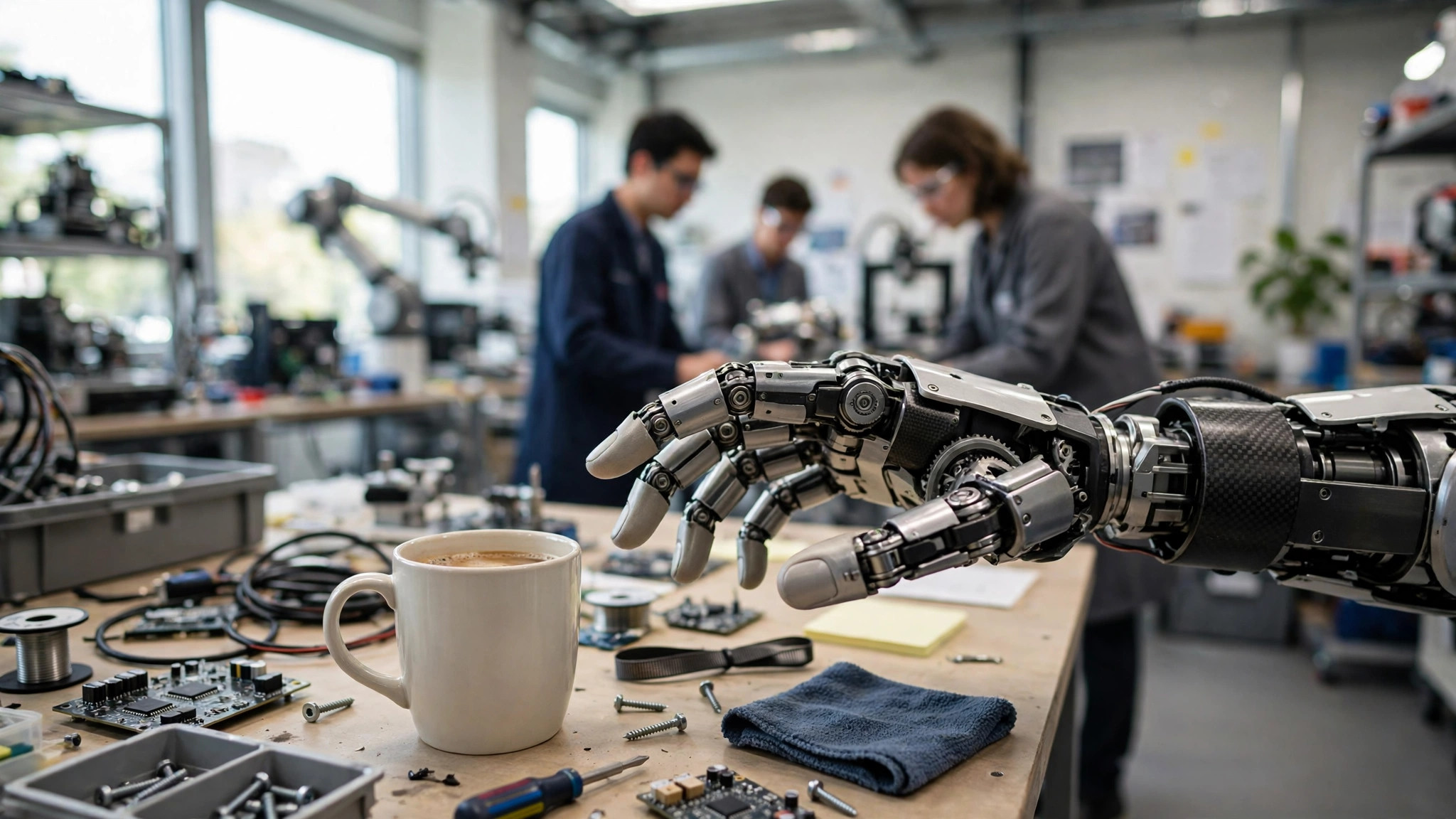
NVIDIA unveiled GR00T 2 on 9 November at the Conference on Robot Learning (CoRL) in Austin, Texas — a 2-billion-parameter “world action model” that learns dexterous manipulation skills from first-person human video. It is built on NVIDIA Cosmos and succeeds the GR00T N1 series of robot foundation models.
Unlike standard vision-language-action models that map camera frames straight to joint movements, GR00T 2 predicts the next few frames of video together with the robot's next actions in a single diffusion transformer. Predicting how objects and hands move in pixel space lets it transfer physical intuition from human videos that carry no robot action labels at all.
The training scale is the story: 402,730 hours of first-person human video, 10,184 hours of handheld gripper demonstrations across 2,897 tasks, and 23,500 hours of robot teleoperation. NVIDIA reports the model completed 40 of 50 evaluated tasks at least once with no task-specific demonstrations, 71% success with one demonstration per task, and 95% with five. Those figures are company-reported.
Alongside the model, NVIDIA released Human-1M-100K, an open 100,000-hour subset of its egocentric video data under a CC BY 4.0 licence, and introduced Isaac Lab 3.0, its open-source robot training framework, now with the Newton physics engine and up to 2.5× the training throughput of version 2.3 on a dexterous manipulation benchmark.
The weights are not out yet: NVIDIA says GR00T 2 and a lighter GR00T 2 Turbo variant will be released as open source in December, along with the training recipe. Nexuni is already testing it for robotic laundry handling, Foxconn is applying it to server-manufacturing automation, and Siemens is evaluating industrial use cases — all testing and evaluation so far, no production rollout announced.