 Aitopkit
⚡ Quick verdict
- The headline number is real — and narrow. GR00T 2 succeeds on 95% of 50 unseen tasks after 5 human demonstrations, in NVIDIA's own tests. That is a genuine leap for robot learning.
- The honest context: 40% with no demo, 71% after one. The model is brilliant at copying a task it just watched a human do a few times — and much weaker at doing something entirely new.
- Nothing to download yet. The weights and code are promised as an open release in December 2026. As of November, GR00T 2 is an announcement and a paper, not a product you can run.
- The real story is the training data. 402,730 hours of first-person human video — robots learning by watching people, not by being hand-programmed for every task.
We may earn a commission if you buy through our links, at no extra cost to you.
Every few years, a robotics announcement arrives with a number so good it sounds like a typo. In November 2026, NVIDIA's was 95%: its new humanoid robot model, GR00T 2, succeeded on 95% of 50 tasks it had never seen before — after watching a human demonstrate each one just five times. For a field where teaching a robot a single new task used to mean weeks of programming or hundreds of robot-collected demonstrations, that number is the whole story. It is also, as usual, a number that needs unpacking before you believe it.
GR00T 2 was launched on November 9, 2026, at CoRL — the Conference on Robot Learning — and it is the biggest robotics launch of the year. It is an open frontier "world action model" built on NVIDIA Cosmos, with 2 billion parameters, designed to turn language instructions and camera input into physical robot actions. Foxconn, Siemens and Nexuni are already trialling it on real work: laundry handling, server manufacturing, industrial tasks. And NVIDIA says the weights and code will be released openly in December 2026, which would make one of the most capable robot brains ever built available to any robotics lab in the world.
This is a researched review, not a hands-on test — nobody outside NVIDIA has run GR00T 2 yet, because the model is not released. Our analysis draws on NVIDIA's launch announcement and technical paper, the test results NVIDIA published, and independent reporting from the launch week in November 2026 — the same sources you would check yourself — organised into honest verdicts. We explain what GR00T 2 is, what the 95% actually measures, what is open now versus what opens in December, and who should care. If you want the wider open-model landscape, our best open source AI models roundup covers the models you can actually download today; for the other big November AI story, our Meta Muse review covers the small model that is already shaking up the chatbot world.
At a glance: NVIDIA GR00T 2
| GR00T 2 | |
|---|---|
| Maker | NVIDIA |
| Launched | November 9, 2026, at CoRL |
| What it is | Open frontier world action model for humanoid robots |
| Built on | NVIDIA Cosmos (world model) |
| Size | 2 billion parameters |
| Training data | 402,730 hours of first-person human video |
| Headline result | 95% success on 50 unseen tasks after 5 demos |
| Zero-shot success | 40% — no demonstration at all |
| One-demo success | 71% — after a single demonstration |
| Early triallists | Foxconn, Siemens, Nexuni |
| Open release | Weights + code promised for December 2026 |
| Available today? | No — announcement and paper only, as of November 2026 |
All figures are NVIDIA's own published test results from the November 2026 launch. Independent verification will only be possible after the December open release — check the official NVIDIA page for the current status.
What GR00T 2 actually is
To understand GR00T 2, start with the problem it solves. A humanoid robot is a general-purpose body: two arms, two hands, cameras for eyes, legs or wheels for movement. The body is the easy part now — the hard part is the brain. A robot that can only do the five tasks it was programmed for is a very expensive single-purpose machine. A robot that can learn a new task by watching a human do it a few times is something else entirely: it is a worker you can retrain in an afternoon.
That is what GR00T 2 is built to be. It is a "world action model" — a model that takes in what the robot sees through its cameras and what it is told to do in language, and outputs the physical actions: where to move the arms, how to grip, how much force to use, in what order. The "world" part matters: the model is built on Cosmos, NVIDIA's world model, which means it has learned how the physical world behaves — how objects move when pushed, how cloth folds, how a grip fails — rather than just memorising sequences of movements. When you tell it to "fold the towel", it does not replay a memorised folding routine; it understands, in the limited way a model can, what folding is.
The model has 2 billion parameters, which is small by chatbot standards — a frontier language model in 2026 is tens or hundreds of times larger — but large for a robot brain that has to run fast enough to control a physical body in real time. A robot cannot wait two seconds to decide its next movement; the model has to think in milliseconds, and 2 billion parameters is a size chosen to fit that constraint while still being capable.
GR00T 2 is the successor to the first GR00T, which NVIDIA announced in 2024 as a foundation model for humanoid robots. The first version proved the idea; the second version is the one with the numbers that matter. The jump between the two is mostly about data: GR00T 2 was trained on far more human video, and the results show it.
The 95%: what it really measures
Here is the number, stated precisely, because the precision is the point. NVIDIA tested GR00T 2 on 50 tasks the model had never seen before — tasks chosen to be new, not variations of its training tasks. The model was shown 5 human demonstrations of each task, then asked to perform it. It succeeded 95% of the time.
That is a real result, and it is genuinely impressive. Teaching a robot a new task from five examples is the kind of sample efficiency the field has chased for a decade. The old way — collecting hundreds of demonstrations with the actual robot, or hand-programming every movement — made every new task expensive. Five human demos, filmed on a regular camera, is cheap enough to do on a factory floor in an afternoon.
But the same test contains two other numbers, and they are the honest context. With no demonstration at all — the model told what to do in language, with nothing to copy — it succeeded 40% of the time. After a single demonstration, 71%. So the curve is steep: 40% at zero demos, 71% at one, 95% at five. Read that curve as a story and it says: GR00T 2 is very good at imitation, and still unreliable at invention. Give it a few examples and it is near-perfect on the tested tasks; ask it to figure something out cold and it fails more often than it succeeds.
There are three more caveats that the headline does not carry. First, these are NVIDIA's own tests, on tasks NVIDIA chose, in settings NVIDIA controls. Independent researchers have not yet had the model to test, and will not until the December release. Second, "success" in a robot test usually means the task was completed to a defined standard — the towel folded, the part placed — not that it was done quickly, gracefully, or the way a human would do it. A robot that succeeds slowly and clumsily still counts as a success. Third, 50 tasks is a meaningful sample but a small one, and the tasks are the kind that can be tested in a lab: manipulation tasks with clear outcomes. Nobody has yet shown GR00T 2 handling the messy, interrupted, ambiguous work that fills a real factory or a real home.
None of this makes the 95% a fake number. It makes it a lab number with a clear meaning: on unseen manipulation tasks, after five human demos, GR00T 2 is extremely reliable. What it does not mean is "robots can now do 95% of jobs", "GR00T 2 works on anything", or "humanoid robots are ready for your home". The distance between a lab benchmark and a working robot in a real building is still measured in years, not weeks — and the honest reporting says so.
Learning from human video: the 402,730 hours
The most interesting fact about GR00T 2 is not the 95%. It is the training data: 402,730 hours of first-person human video. That is roughly 46 years of continuous footage, filmed from the point of view of the person doing the task — hands reaching, gripping, folding, assembling, carrying. It is the largest dataset of its kind ever used to train a robot model, and it represents a bet about how robots should learn.
The old bet was robot data: you put a robot in a lab, you have it attempt tasks thousands of times, you record what worked, and you train on that. The problem is scale — robots are slow, expensive, and break. You can generate a few thousand hours of robot data a year if you try hard. Humans, by contrast, generate video of themselves doing things constantly, and a head-mounted camera turns an ordinary workday into training data. NVIDIA's bet is that watching humans is a better teacher than watching robots, because humans are already good at the tasks, and because there is so much more human video in the world.
That bet is also why five demonstrations are enough. GR00T 2 does not learn a task from scratch when it watches your five demos — it already knows, from those 402,730 hours, how hands move, how objects behave, what a fold looks like, what a grip feels like. The five demos are not teaching it the physics; they are telling it which of the many things it already knows to do, in this specific case, in this specific order. The demonstrations are a pointer, not a lesson. That is the difference between a world model and a memorised routine, and it is the technical heart of the GR00T 2 story.
There is an honest limit to this approach too. Human video teaches a robot what human hands do — but a robot's hands are not human hands. Different grippers, different strength, different dexterity: a movement that is trivial for a human wrist can be impossible for a robot arm, and the model has to bridge that gap. The 95% suggests the bridge is working on the tested tasks. Whether it holds across the much wider range of robot bodies in the real world — different arms, different hands, different sizes — is an open question that the December release will start to answer.
What is open now vs what opens in December
This is the part of the story where careful readers should slow down, because the word "open" is doing a lot of work in the GR00T 2 coverage. NVIDIA calls GR00T 2 an open model. What that means, concretely, is a promise: the weights and the code will be released openly in December 2026. As of November 2026, that release has not happened. There is nothing to download, nothing to run, and no independent researcher has verified the 95% on their own hardware.
That matters for two reasons. First, the entire evaluation in this article — and in every other article published in November — rests on NVIDIA's own numbers. That is normal for a launch week, and NVIDIA's robotics team has a strong record, but it is still a single source. The history of AI is full of launch numbers that shrank when independent labs got the model. Second, the December release is itself a test: "open" can mean many things, from fully open weights with a permissive licence to weights with restrictions on commercial use. The details will only be clear when the release lands, and they will decide whether GR00T 2 becomes a shared foundation for the whole robotics field or a showcase that most labs can only admire.
If the release is genuinely open — weights, code, and a licence that allows commercial use — the consequences are large. Every robotics lab in the world would get a frontier robot brain for free, and the pace of humanoid development would accelerate sharply: startups that could never afford to train a model like this could build on top of it instead. That is the promise NVIDIA is making, and it is the reason the launch matters beyond the benchmark. If the release is restricted, the story is smaller: an impressive NVIDIA demo that stays inside NVIDIA's ecosystem. December will tell.
Until then, the practical advice is simple: do not plan a project around GR00T 2 yet. Watch the December release, read the licence, and wait for the first independent tests. The model will still be there in January, and by then someone else will have run it on their own robot and told you what actually happened.
Who is trialling it, and on what work
NVIDIA names three companies trialling GR00T 2: Foxconn, Siemens and Nexuni. The choice of names is deliberate — each one represents a different kind of real work, and together they sketch the map of where humanoid robots are headed first.
Foxconn is the world's largest electronics manufacturer, and its interest is server manufacturing: the precise, repetitive, high-volume assembly work that fills its factories. A humanoid that can learn a new assembly step from five demonstrations is a different proposition from a fixed industrial robot that must be reprogrammed for every change — and server manufacturing changes constantly, as new models and new components arrive. The trial is about flexibility: can a general-purpose robot keep up with a production line that never sits still?
Siemens is the industrial giant, and its trial is about industrial work more broadly — the maintenance, inspection and handling tasks inside plants and warehouses. Siemens has been building the software layer for industrial automation for decades, so its interest in GR00T 2 is a signal about where the industry thinks the next layer goes: not a better fixed robot, but a general-purpose one that can be retrained for the next job.
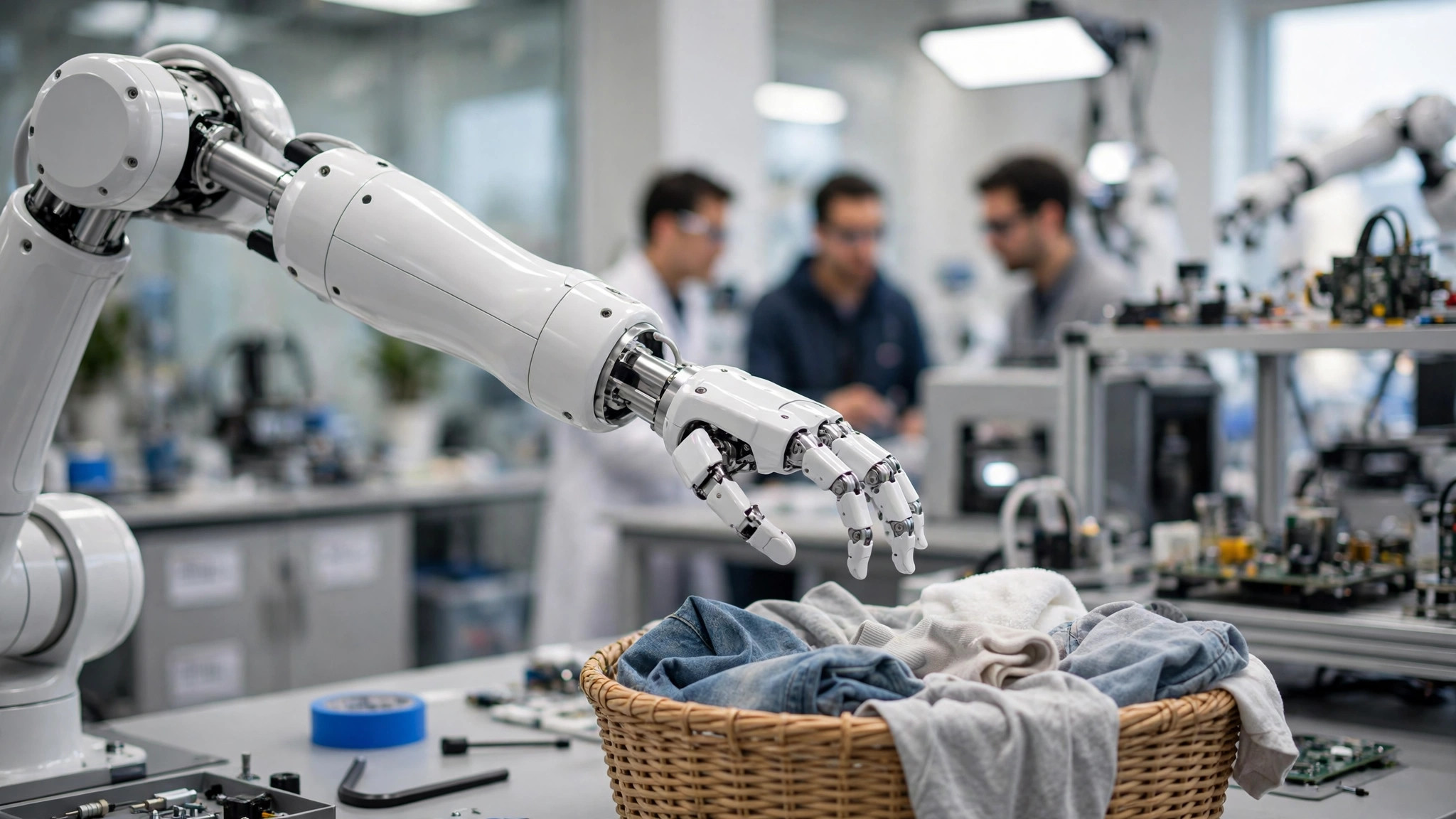
Nexuni is the most human of the three: its trial involves laundry handling — the folding, sorting and moving of linens that is a staple of hotels, hospitals and care facilities. Laundry is the perfect test for a world action model, because cloth is the hardest material in robotics: it folds, it slips, it has no rigid shape, and every item is different. If GR00T 2 can handle laundry reliably, it can handle a large class of soft, variable real-world tasks that have defeated robots for years.
Be clear about what these trials are: early tests with partner companies, not production deployments. Nobody is announcing that Foxconn's factories are now staffed by GR00T 2 robots, and nobody should read it that way. The trials are the stage where a lab result meets a real building — different lighting, different floors, different objects, different interruptions — and where the gap between 95% in the lab and reliability in the field gets measured honestly. The results of these trials, if NVIDIA and its partners share them, will be the most important GR00T 2 news of early 2027.
What GR00T 2 can and cannot do
On the evidence published so far, GR00T 2 can do one thing extremely well: learn a physical manipulation task from a handful of human demonstrations and then perform it reliably in a controlled setting. That covers a large and valuable class of work — picking, placing, folding, sorting, assembling, handling — the tasks that fill factories, warehouses, laundries and workshops. The five-demo learning curve is the capability that matters, because it turns retraining from a project into an afternoon.
It can also do something subtler that matters for the long run: understand instructions in language and connect them to physical action. "Put the red box on the top shelf" is not a program; it is a sentence, and GR00T 2 has to parse the sentence, find the box, plan the reach, and execute the placement. That language-to-action bridge is what makes a general-purpose robot general-purpose, and it is the capability that separates a world action model from a traditional industrial controller.
What it cannot do — or has not shown it can do — is just as important. It cannot reliably do a task it has never seen, with no demonstration: 40% zero-shot success is a long way from trustworthy. It cannot reason its way out of an unexpected situation the way a human worker can — a dropped object, a jammed drawer, a colleague in the way. It cannot work for a full shift without supervision, and it cannot be trusted with safety-critical work on its own. And it cannot do any of this yet outside NVIDIA's own tests, because the model is not released.
There is also a cost question that rarely makes the launch coverage. A humanoid robot body, the compute to run a 2-billion-parameter model in real time, the cameras, the maintenance — the robot is not cheap, and the economics only work where the labour it replaces is expensive or scarce, or where the work is dangerous or unpleasant. Laundry, server assembly and industrial handling all fit that description. Your home does not, yet.
GR00T 2 vs the rest of the robot world
GR00T 2 does not arrive in a vacuum. The humanoid race in 2026 is crowded: Tesla's Optimus, Figure's humanoids, Boston Dynamics' Atlas, and a dozen well-funded startups are all building general-purpose robots, and most of them have their own models. What makes GR00T 2 different is not the robot — NVIDIA does not build the bodies — but the brain, and the decision to open it.
Most robot companies keep their models private: the model is the moat, the thing that makes their robot better than the next company's robot. NVIDIA's business is the opposite. NVIDIA sells the chips and the software platform that everyone else's robots run on. An open GR00T 2 makes every humanoid better, and every better humanoid needs more NVIDIA compute. The open release is not generosity; it is strategy — the same strategy that made CUDA the standard for AI computing. If GR00T 2 becomes the default brain for humanoid robots, NVIDIA wins even if it never sells a single robot.
That also means the comparison that matters is not GR00T 2 against one rival robot, but GR00T 2 against the closed alternative: a world where each robot company trains its own model on its own small dataset, versus a world where everyone builds on a shared open model trained on 402,730 hours of human video. The second world moves faster, and it moves faster for everyone — including the small labs and startups that could never afford to train a model like this themselves. That is the bet, and December is when we find out how real it is.
For readers who follow the open-model world more broadly, our best open source AI models roundup covers the language and image models you can download today — GR00T 2, if the December release holds, joins that list as the first open frontier model for physical work. And for the other direction of the same trend — small models doing big jobs — our Meta Muse review covers the tiny model that tied Claude Haiku at a third of the cost.
The December window: what to watch for
The weeks between now and the December release are the most important part of the GR00T 2 story, because they are when the promise gets tested. There are five things to watch, and each one answers a different question about what GR00T 2 will actually become.
First, the licence. "Open" is a spectrum, and the licence decides where on it GR00T 2 lands. A permissive licence that allows commercial use would let startups and factories build products on the model; a research-only licence would limit it to labs. Read the licence text when it lands — not the launch blog post, the actual licence — because that document, more than the benchmark, decides who gets to use GR00T 2 and for what.
Second, the first independent tests. Once researchers can download the model, they will run it on their own robots, on their own tasks, in their own labs — and the numbers will either hold or shrink. Pay attention to the tests that use different robot bodies from NVIDIA's own, because a model that only works well on one specific humanoid is a narrower achievement than a model that transfers across platforms. GR00T 2 sits inside NVIDIA's wider Isaac robotics platform, and the question is how tightly it is tied to NVIDIA's own hardware and simulation tools.
Third, which tasks the independent tests choose. NVIDIA's 50 tasks were manipulation tasks with clear outcomes. The interesting tests will be the messy ones: tasks with interruptions, with objects the model has never seen, with instructions that are vague or ambiguous. A model that scores 95% on clean lab tasks and 50% on messy ones is still a breakthrough — but it is a breakthrough with a much longer road to the factory floor.
Fourth, the compute question. A 2-billion-parameter model running in real time needs serious hardware on the robot itself, and that hardware costs money, draws power, and generates heat. Watch for the first reports of what GR00T 2 needs to run — which chips, how much memory, how fast — because the compute requirement is the hidden price tag, and it decides whether the model is practical for anyone except the best-funded labs.
Fifth, the trial results. Foxconn, Siemens and Nexuni are testing GR00T 2 on real work right now, and if they share even partial results in early 2027, those results will matter more than any benchmark. A laundry trial that reports "it folds reliably for four hours, then needs a reset" tells you more about the state of humanoid robotics than any launch number. Watch for those reports, and read them with the same scepticism you would apply to any vendor claim — but read them, because they are the closest thing to ground truth this field has.
Who should care about GR00T 2
- Robotics researchers → watch December. If the weights and code release openly, GR00T 2 becomes the foundation to build on. Do not plan a project around it until the licence is public and the first independent tests are in.
- Manufacturing and logistics leaders → watch the Foxconn and Siemens trials. The question is not whether GR00T 2 works in a lab, but whether it holds up on a real production floor. The trial results will tell you more than any benchmark.
- Investors in robotics and automation → understand the strategy. NVIDIA is not selling robots; it is selling the platform every robot runs on. An open GR00T 2 strengthens that position, and it raises the bar for every closed-model competitor.
- Developers and startups → the December release is your moment. A frontier robot brain you can download changes what a small team can build. Start with the licence and the compute requirements, not the hype.
- General readers → enjoy the milestone, keep the timeline honest. GR00T 2 is a genuine leap in robot learning, and the five-demo result is the most important robotics number of the year. It is not a robot you can buy, and it is not a workforce that is about to arrive. The lab-to-factory gap is still measured in years.
The bottom line is simple: GR00T 2 is the most capable robot-learning model ever announced, and the 95% is a real result on a well-defined test. The open release in December will decide whether it becomes a shared foundation for the whole field or a showcase. Either way, the direction is clear — robots are learning the way humans do, by watching — and the next few years of robotics will be written by whoever learns fastest from that idea.
Frequently asked questions
What is NVIDIA GR00T 2?
GR00T 2 is NVIDIA's open frontier world action model for humanoid robots, launched on November 9, 2026, at the Conference on Robot Learning (CoRL). It is a 2-billion-parameter model built on NVIDIA Cosmos that turns language instructions and camera input into physical robot actions. Unlike earlier robot models trained mostly on robot-collected data, GR00T 2 learns from human video — 402,730 hours of first-person video in its training — so it can pick up new tasks from a handful of human demonstrations.
What does the 95% success rate actually mean?
The 95% figure measures success on 50 unseen tasks in NVIDIA's test setup after the model was shown 5 human demonstrations of each task. The same tests show 40% success with no demonstration at all (zero-shot) and 71% after a single demonstration. So the honest reading is: GR00T 2 is very good at copying a task it has just watched a human do a few times, and much weaker at doing something it has never seen. It does not mean a robot can do 95% of real-world jobs.
Is NVIDIA GR00T 2 open source?
Not yet, as of November 2026. NVIDIA announced GR00T 2 as an open model and says the weights and code will be released openly in December 2026. Until that release happens, researchers and developers cannot download or run the model themselves — what exists today is the announcement, the paper and NVIDIA's own test results. Check NVIDIA's official GR00T page for the release status before planning any work around it.
Who is using GR00T 2?
NVIDIA names Foxconn, Siemens and Nexuni among the companies trialling GR00T 2, in settings that include laundry handling, server manufacturing and industrial work. These are early trials with partner companies, not production deployments — the robots are being tested on real factory and service tasks to see where the model holds up outside the lab. Wider adoption depends on the December open release and on results from these trials.
How does GR00T 2 learn from human video?
GR00T 2 is trained on 402,730 hours of first-person human video — footage of people doing everyday tasks with their hands, filmed from their own point of view. Because the model is built on Cosmos, NVIDIA's world model, it learns the physics of those tasks: how objects move, how hands grip, what happens when you push, lift or fold something. That is why a few demonstrations are enough to teach it a new task — it already understands the physical world from watching humans, and the demo shows it what to do in this specific case.
Can I run GR00T 2 on my own robot?
Not yet. The weights and code are scheduled for open release in December 2026, and until then there is nothing to download. Even after release, GR00T 2 is a 2-billion-parameter model that needs serious compute and a compatible humanoid robot platform to run — it is a research and industrial tool, not something you install on a home robot. If you are a robotics researcher or developer, the December release is the moment to watch; if you are a general reader, the honest answer is that GR00T 2 is a milestone for the field, not a product you can use today.